
The Shadow Under the Awning
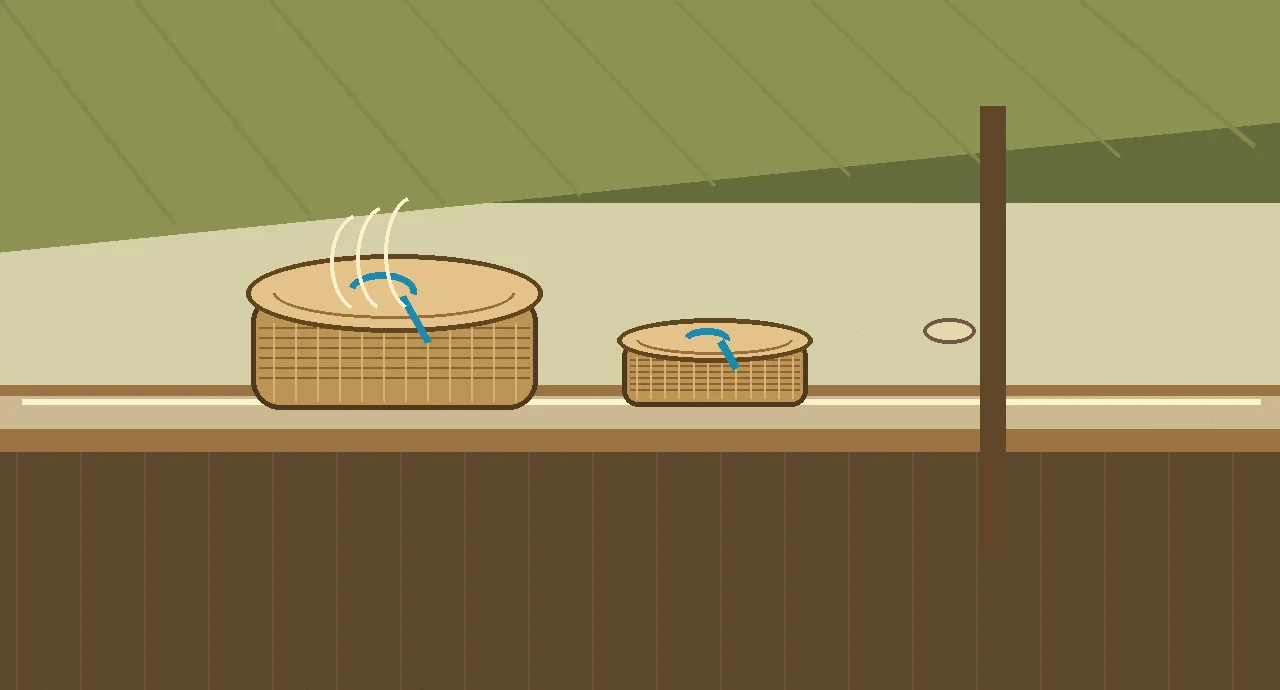
The prototype opens with a stall that is still mostly in the shade. A patch of daylight reaches the street side first. Behind the counter, the vendor sees a stripe across the wood and a loop of blue ribbon above it. Out in the street, the waiting visitor sees more pavement and less of the basket. The two drawings are supposed to show the same moment. For the person playing from either view, they need to show enough of the same arrangement to make a choice about it.
This article records the lighting study for The Lid with a Blue Tie. The study has three positions for the edge of the shadow. The basket, serving stripe and waiting mark stay in one place. Holding those objects still makes it possible to inspect what the light itself changes before adding a new order or moving a visitor.
Give the shadow one job
The first sketch used a hard boundary across the width of the counter. It separated the hot preparation area from the lighter edge where an order goes out. At full size, that looked like a clear distinction. On a narrow screen, the edge of the shadow and the serving stripe were so close that they read as one line. A player who used that line for placement could end up following the one that moves during the morning.
The next drawing puts the darkest edge across the wall behind the vendor and lets the light soften where it reaches the shelf. The pale serving stripe can then continue across both areas. To tell those marks apart, look at the ends. The painted stripe stops at the outer corner of the board. The shadow continues up and across a different surface. The boundary tells you what time of morning the scene suggests. The paint tells you where the vendor can set something down.
Let the viewpoint change
We draw the scene from two positions at the same time in the prototype. From the steamer, the ribbon is near the front of the frame. From the street, the basket sits behind the rim of the shelf and the knot is much smaller. The useful question is whether a reader can still find the lid after looking away. A clear landmark at one angle does little good if the matching drawing hides it behind another object.
We kept the small notch in the lid and left a gap around the knot rather than enlarging the patch of blue. The gap keeps a recognizable outline even when the color is hard to distinguish. At the street angle, an unobstructed corner of the board gives the reader a second point from which to find the basket. The close drawing can explain the knot. The full drawing needs to locate it in relation to the queue.
Check the drawing at the moment of a choice
An illustration can be clear while the stall is empty and become confusing when an order sits on the shelf. To test the serving edge, we add a tray directly beside the stripe and repeat the same play turn at all three shadow positions. The mark should still tell the player where the next order belongs. If the tray hides a necessary part of the mark, the interface can show who is waiting beside that shelf segment. The room and the order board should agree.
In A Place on the Serving Shelf, the handover is read from farther away, and most of the visible light falls on the street. That makes it a useful check on the same drawing decisions. A visitor can read their waiting outline and still miss which part of the shelf is free. In the Basket Tests comparison, follow the physical line across each view before looking back at the basket. The two studies use the same setting to test different decisions about what belongs in view.