
The Lid with a Blue Tie
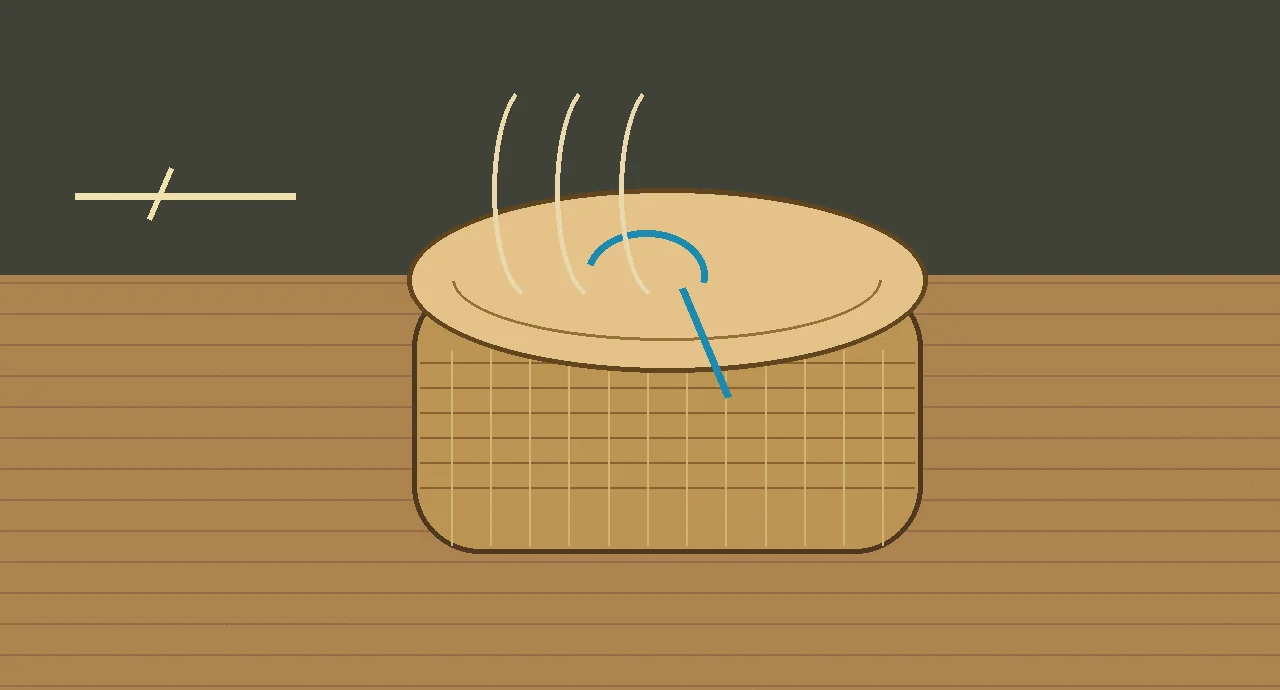
The first person to reach the stall has stopped short of the counter, where the street is wide enough for another bicycle to pass. From behind the counter, you can see a covered basket and the corner of a pitcher. A short blue ribbon runs through the handle of the lid. Below it, one chalk stroke records the order you have started. You need to get the basket to the right place while keeping enough room for the order that follows. The Lid with a Blue Tie is a prototype about making that decision with small, persistent clues.
Inspect the counter before moving the basket
Choose a viewpoint at the steamer or the serving shelf. At the steamer, the ribbon and the side of the basket are easy to examine, but the visitors are mostly silhouettes. At the shelf, you can see which visitor is ready and where the chalk stripe crosses the wood. Your first action leaves the other viewpoint available. Going back costs a turn in the prototype, and the state that has already changed stays visible in both views. This lets you test memory against a shared object.
At either viewpoint, you can hold, check or move the basket. Holding allows the queue to advance to the next marked position. Checking opens a close drawing for one turn and reveals a cue about the order. Moving the basket updates the counter layout and exposes the shelf below it. The next drawing includes the old chalk mark, the latest order and the basket’s changed location. Use those clues to decide whether the move opened a useful space or occupied a space assigned to somebody else.
Learn from the first handover
The prototype starts with one waiting visitor and an empty serving section. A second scenario starts in the same room with two visitors and a shelf already set aside. The contrast is easiest to see when you make the same move in both situations. In the second, setting down the blue-tied basket may take away the space needed for a different order. One possible recovery is to reconsider a marked position and return the basket to the preparation counter. That recovery has a visible cost in waiting turns. It also leaves a new arrangement you can read before choosing again.
A short recap preserves three views of the decision. It shows what you could see before the move, where you placed the basket, and which order advanced afterward. The recap tests whether the cause of a delay is clear from the scene. If a player needs the recap on every turn, the chalk and ribbon may need a clearer relationship in the play view.
Keep the landmark legible
Art direction begins with the warm brown of the counter and a muted green behind the stall. The blue tie is a small accent beside the bamboo rather than a bright item floating above it. Its loop stays legible from both angles. The drawings pair the accent with a visible knot and a shallow notch in the lid so players can identify the basket when they have trouble distinguishing colors. Shape, label and order remain available at smaller screen widths.
The prototype tests the timing and reading of one move. The companion study, A Place on the Serving Shelf, starts at the point where that move has to make sense to a visitor. Use the basket comparison to examine the two sets of cues together.