
A Place on the Serving Shelf
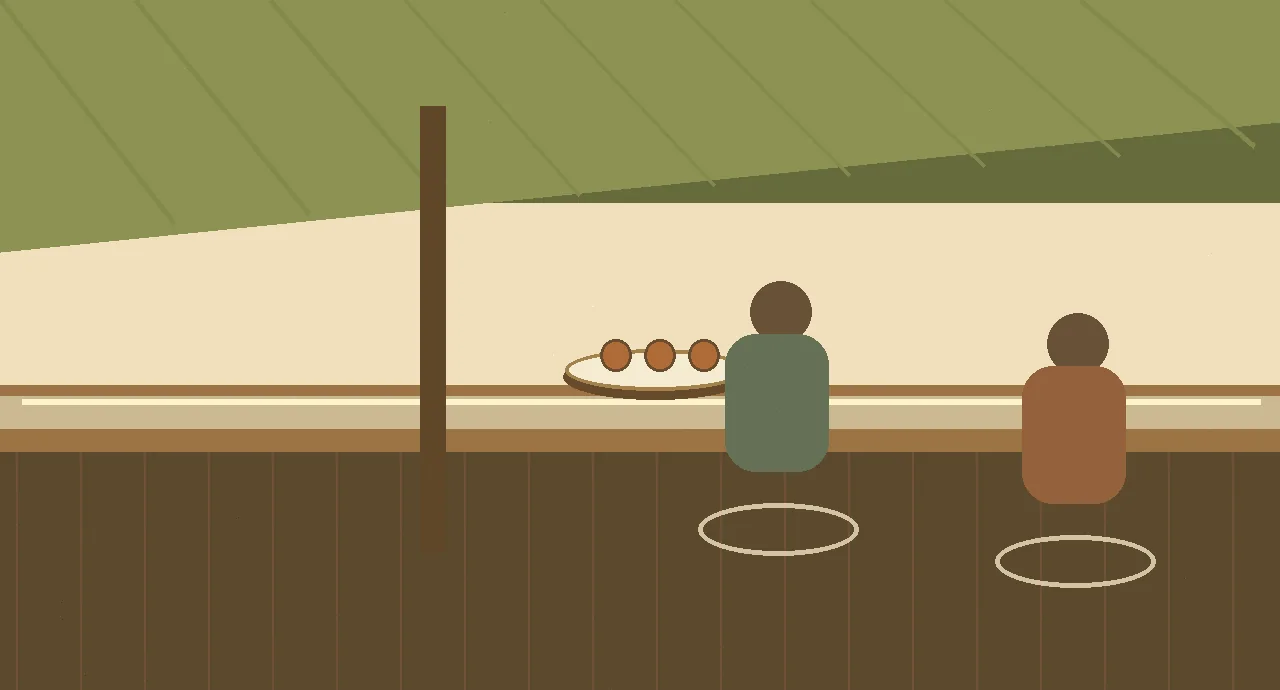
From the street, the serving shelf looks like a narrow strip under the awning. You can see two visitors waiting near the front, a chalk stripe across the wood and a dry patch where the edge of a tray has just been lifted. The person behind the counter can reach from one end to the other. A visitor can only see the section directly in front of them. A Place on the Serving Shelf is a game concept about making the last step of a breakfast order readable from both sides of that edge.
Read the shelf from the street
Start by tracing the marked segment nearest the current visitor. The board beside the opening shows the order you are about to hand over. The shelf drawing shows which places are clear, temporarily assigned or reachable only from the side. Choose a place for the finished order. The view then shifts far enough to show what the visitor can reach without stepping into the next waiting position.
Between turns, one visitor can step forward, collect an order or wait for a better opening. Their position is shown by a full silhouette and a mark on the ground. As the perspective changes, the mark remains fixed. You can compare where the person started to where they ended up. This gives the prototype a way to show a missed handover without asking the player to remember a small floating icon.
Trade a short wait for a clearer handover
A visitor near the right post might be able to reach an order set down toward the middle. Using that space could make the next handover confusing if a different person is already approaching the center. If you leave the center free, the current visitor waits another turn while you choose a space nearer the post. The next visitor then arrives at an opening that already matches their place. Both outcomes can be playable. The value of the move depends on which visitor is ready and whether the next order can travel over the same patch of counter.
When you replay a turn, the drawing restores the queue and the order board to their earlier positions. It changes only the placement of the finished order and follows the result. A good repeat makes it possible to say where the problem started. If the result is confusing, the next iteration should improve the shared view of the counter or make the ownership of an empty slot easier to read.
Design a shelf that survives a change of angle
The art puts the chalk line on a shallow beveled board, where it can still be seen from behind the counter and from the street. The serving edge is lighter than the preparation table. A lamp brightens a narrow patch of wood as the morning begins. The marks still need to read when the lamp is outside the frame. Each waiting place has a different outline cut into the pavement, with words available beside the drawing. A static view keeps the outline and order visible for readers who use reduced motion.
This is a concept in prototype development. The small scope helps us test whether arranging two handovers can carry a scene. For the preparation side of the same stall, follow The Lid with a Blue Tie. The comparison tray collects shelf and counter details alongside each other.